A Brief History of Fascism
Fascism was born in the chaos after World War I and spread across Europe in the 1920s and 1930s. Here is how it happened — and how it ended.
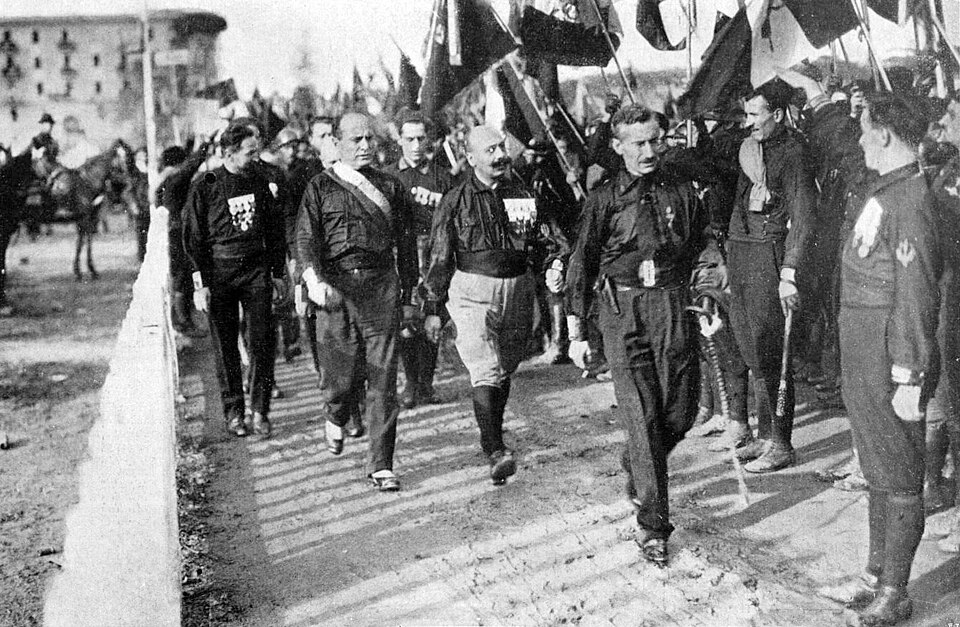
Fascist rally in Naples, October 24, 1922 — days before Mussolini's March on Rome. Public domain, Wikimedia Commons.
The Birth of Fascism
The word "fascism" comes from the Latin fasces — a bundle of wooden rods with an axe blade, an ancient Roman symbol of authority. Benito Mussolini adopted it in 1919 when he created Italy's fascist movement.
Italy was struggling after World War I. Even though Italy won the war, its people faced poverty, unemployment, and political chaos. Mussolini promised to restore Italy to the glory of the Roman Empire. His followers, the "Blackshirts," used violence to intimidate opponents.
On October 28, 1922, roughly 30,000 Blackshirts marched on Rome. Instead of stopping them, King Victor Emmanuel III invited Mussolini to form a government. By 1925, Mussolini had dismantled democracy and declared himself il Duce ("the Leader") — a dictator with unchecked power.
Mussolini was captured and executed by Italian partisans on April 28, 1945.
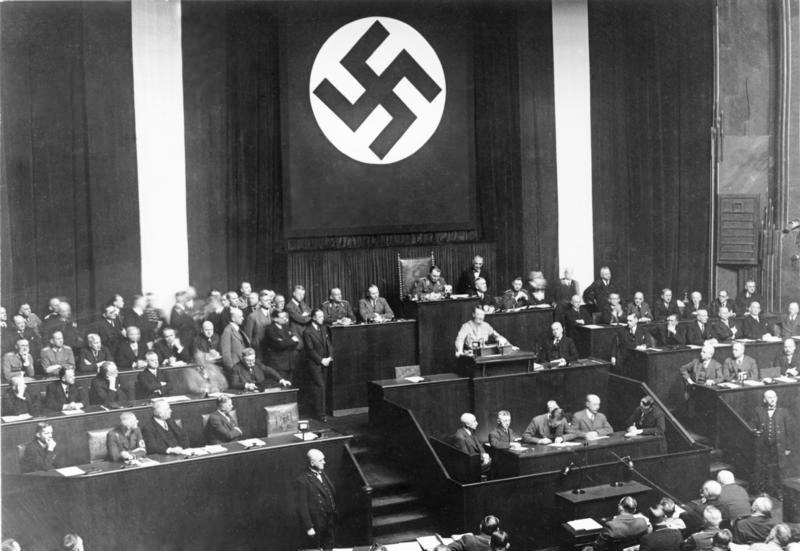
Hitler addresses the Reichstag during the Enabling Act debate, March 23, 1933. German Federal Archives (Bundesarchiv).
Nazi Germany: Fascism at its Worst
After World War I, Germany's Weimar Republic was fragile. The economy collapsed, unemployment skyrocketed, and extremists on both the left and right competed for power.
Adolf Hitler and the Nazi Party exploited this misery. After a failed coup attempt in 1923, Hitler realized he could destroy democracy from within by winning elections. By 1932, the Nazis were the largest party in parliament.
On January 30, 1933, conservative politicians who thought they could control Hitler convinced the president to appoint him Chancellor. They were catastrophically wrong. Within weeks, Hitler used a fire at the parliament building (the Reichstag) as an excuse to suspend civil liberties. On March 23, 1933, the Enabling Act gave him the power to make laws without parliament — the cornerstone of his dictatorship.
The Nazi regime murdered six million Jews and millions of other people in the Holocaust. Germany surrendered on May 8, 1945, after total military defeat.
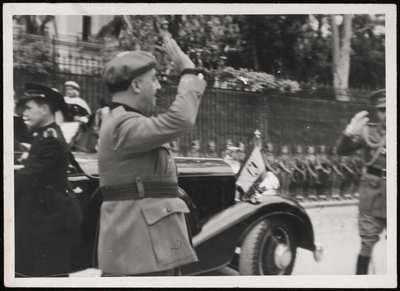
Franco's victory parade in Madrid, 1939. Public domain, Wikimedia Commons.
Franco's Spain: The Longest Fascist Regime
In 1936, General Francisco Franco launched a military rebellion against Spain's elected government, starting the Spanish Civil War (1936–1939). Hitler and Mussolini both sent troops and weapons to help Franco. The Soviet Union backed the other side.
Franco won in 1939 and ruled Spain as dictator for 36 years — the longest fascist-style dictatorship in Europe. His regime suppressed free speech, banned political parties, censored the press, and brutally punished dissenters.
Unlike Mussolini and Hitler, Franco died of natural causes in 1975. Remarkably, King Juan Carlos I then guided Spain through a peaceful transition to democracy. Spain ratified a democratic constitution in 1978.
Fascism Wasn't Just European
Fascist and fascist-style movements appeared around the world:
- Japan (1930s–1945) — Military leaders gradually took control, teaching racial superiority and pursuing violent expansion across Asia. Ended by military defeat in WWII.
- Portugal (1933–1974) — Antonio Salazar's "New State" banned political parties and used secret police. Ended by the Carnation Revolution in 1974 — soldiers put flowers in their gun barrels.
- Argentina (1940s–1950s) — Juan Perón studied Mussolini's Italy firsthand and brought authoritarian populism home. Overthrown by a military coup in 1955.
- United States — The Ku Klux Klan and the German-American Bund promoted fascist-aligned ideas of white supremacy in the 1930s, though neither achieved political power.
“Ur-Fascism can come back under the most innocent of disguises. Our duty is to uncover it and to point our finger at any of its new instances — every day, in every part of the world.”— Umberto Eco, “Ur-Fascism,” 1995
The 14 Warning Signs of Fascism
In 1995, Italian scholar Umberto Eco — who grew up under Mussolini's regime — published an essay called "Ur-Fascism" (meaning "Eternal Fascism"). In it, he identified 14 features that appear again and again in fascist movements. Eco warned: "It is enough that one of them be present to allow fascism to coagulate around it."
The Cult of Tradition
Fascism treats ancient wisdom and tradition as sacred and unquestionable. It mixes ideas from different cultures and time periods, even when they contradict each other, because the point isn't logical consistency — it's the belief that all truth has already been revealed.
Rejection of Modernism
Fascism may embrace technology (tanks, rockets, social media), but it rejects the Enlightenment values that created modern democracy: reason, science, individual rights, and critical thinking. The Age of Reason is painted as the beginning of moral decay.
Action Over Thinking
Doing something — anything — is valued more than thinking carefully first. As Eco wrote, "Thinking is a form of emasculation." Universities, scientists, and intellectuals are viewed with suspicion or open hostility.
Disagreement Is Treason
Any questioning of the movement, its leader, or its ideas is treated not as healthy debate but as betrayal. In a democracy, disagreement is normal. Under fascism, it's dangerous.
Fear of Difference
Fascism exploits people's unease with those who are different. The first appeal is always "against the intruders." This shows up as racism, xenophobia, and hostility toward immigrants, LGBTQ+ people, or anyone labeled an outsider.
Appeal to a Frustrated Middle Class
Fascism recruits from people who feel economically squeezed, politically ignored, or frightened by those below them on the social ladder. It tells them their problems aren't caused by the system — they're caused by other people.
Obsession with a Plot
Followers must feel under siege. There is always an enemy conspiracy — shadowy, powerful, international — threatening the nation from within and without. Xenophobia and conspiracy thinking combine into a toxic brew.
The Enemy Is Both Strong and Weak
Enemies are portrayed as simultaneously all-powerful and pathetic. They control everything, yet they are also degenerate and inferior. This contradiction is never resolved — it just shifts depending on what the moment requires.
Pacifism Is Treason
Life is permanent warfare. Since the struggle never ends, anyone who calls for peace or compromise is helping the enemy. Eco wrote: "There is no struggle for life — there is life for struggle."
Contempt for the Weak
In fascism, every citizen supposedly belongs to the best people in the world. But within the group, hierarchy is rigid: every leader looks down on those beneath him, and everyone looks down on outsiders. Weakness is contemptible.
The Cult of Heroism and Death
Everyone is expected to become a hero. Dying for the cause is glorified as the ultimate reward. In practice, the leaders preach sacrifice while sending others to die.
Machismo and Weapons
Since permanent war and heroism are difficult to sustain, fascism transfers its obsession with power to gender roles. This produces machismo, contempt for women, hostility toward LGBTQ+ people, and the worship of weapons as symbols of strength.
Selective Populism
In democracy, citizens have individual rights. In fascism, only "the People" (as a single block) have a will — and only the Leader can interpret it. This means elections, courts, and legislatures are declared corrupt because they don't produce the "right" result.
Newspeak
Borrowing a term from George Orwell's 1984, Eco described how fascism deliberately simplifies language. Short slogans replace complex ideas. Vocabulary shrinks so people lose the tools they need for critical thinking.
Fascism in Fiction
Some of the most popular movies, books, and TV shows of our lifetime have been warnings about fascism. Their creators didn't invent these stories out of thin air — they drew directly from history. Here are four fictional fascist regimes and what they teach us.
The Galactic Empire
Emperor Palpatine engineers a fake war (the Clone Wars) to get emergency powers from the Senate — then uses those powers to abolish the Senate entirely and declare himself Emperor. Sound familiar? It should.
- Enabling Act parallel: Palpatine's emergency powers mirror Hitler's 1933 power grab. Lucas confirmed this was intentional.
- Nazi aesthetics: Imperial uniforms are modeled on Wehrmacht/SS dress. "Stormtroopers" are named after the Nazi SA. Rally scenes echo Riefenstahl's Triumph of the Will.
- Racial supremacy: The Empire practices species-based discrimination, excluding non-humans from power — mirroring Aryan supremacy ideology.
- Rule through terror: The Death Star embodies the fascist doctrine that peace comes through overwhelming destructive force.
Norsefire
After a manufactured plague kills 100,000 people, the Norsefire party uses the resulting fear to win elections and establish a fascist dictatorship in Britain. The Chancellor rules through surveillance (the Eye), secret police (the Finger), and state propaganda (the Mouth).
- Manufactured crisis: Norsefire creates the plague itself, then uses fear to seize power — echoing the Reichstag Fire.
- Concentration camps: Larkhill Camp is an explicit Holocaust parallel — targeting minorities, LGBTQ+ people, and political opponents.
- Total surveillance: Named divisions (Eye, Ear, Nose) mirror the Gestapo and Stasi surveillance networks.
- State media: Lewis Prothero, "The Voice of London," is a direct parallel to Goebbels' propaganda ministry.
The Republic of Gilead
Religious extremists stage a terrorist attack, blame it on others, suspend the Constitution, and establish a theocratic dictatorship in the former United States. Women are stripped of all rights. Fertile women are forced into sexual slavery. Reading is illegal for women.
- False flag & constitutional destruction: The Sons of Jacob massacre Congress and declare martial law — a direct Enabling Act parallel.
- Enforced caste system: Color-coded castes (red, blue, green, grey) mirror Nazi concentration camp badges and fascist social hierarchies.
- State control of reproduction: Forced childbearing parallels the Nazi Lebensborn program and Romania's Decree 770 (the "menstrual police").
- Religion as control: Like Franco's Spain, Gilead fuses religious authority with totalitarian state power.
The Capitol / Panem
Panem's Capitol forces 12 districts to send children to fight to the death on live television every year. The nation's name comes from the Latin panem et circenses ("bread and circuses") — the Roman strategy of using food and entertainment to distract people from their own oppression.
- Spectacle as control: The Games mirror the 1936 Nazi Olympics and fascist regimes' use of televised events to project power and normalize violence.
- Economic exploitation by district: Each region produces a single commodity for the Capitol, mirroring fascist colonial extraction economies.
- Collective punishment: District 13's destruction echoes the Nazi destruction of Lidice — entire communities erased as punishment for resistance.
- Silencing dissent: "Avoxes" (people with tongues cut out) are a visceral symbol of how fascism literally silences opposition.