Request to Speak (RTS)
The single most powerful tool everyday citizens have at the state level.
Arizona's Request to Speak system is an official tool provided by the Arizona Legislature that lets you register your position — for, against, or neutral — on any bill being heard in committee. Committee chairpersons receive your position electronically before hearings, so your voice is counted even if you never set foot in the Capitol.
Here's the catch with the official system: to activate your account, you must physically visit the Arizona Capitol in Phoenix and use a kiosk on the first floor. After that initial visit, you can sign in from home for future sessions.
Skip the Trip — Sign Up Through CEBV
The folks at Civic Engagement Beyond Voting (CEBV) have streamlined the RTS signup process. Instead of driving to the Capitol, you can create your account through their simple online form. CEBV is a grassroots Arizona 501(c)(4) organization dedicated to empowering residents to participate in state and local governance.
Sign Up for RTS via CEBVHow RTS Works
- Create your account — Sign up through CEBV's RTS page (recommended) or the official AZ Legislature portal.
- Find bills that matter to you — Browse upcoming committee agendas at apps.azleg.gov.
- Register your position — Select For, Against, or Neutral on any bill. You can also leave a comment for committee members.
- Your position is delivered — Committee chairs receive the list of registered speakers and their stances before the hearing.
You do not need to physically testify to have your position counted. RTS is available during the legislative session (typically January through late spring).
Contact Your Legislators
They work for you. Remind them.
Every Arizonan is represented by one State Senator and two State Representatives in the Arizona Legislature. These are the people voting on the bills that affect your daily life — and they are required to listen to their constituents.
Phone calls are more effective than emails. Emails are more effective than silence. A handwritten letter is more effective than both. The key is to be specific: reference the bill number, state your position clearly, and explain why it matters to you personally.
Find Your Legislators
Use our Who Represents Me? tool to look up your district, find your legislators, and get their contact information.
Find Your LegislatorsTips for Effective Contact
- Call during business hours — You'll reach a staffer who logs your position. Keep it brief: your name, your district, the bill number, and your position.
- Be a constituent — Legislators prioritize feedback from people in their district. Always mention that you live in their district.
- Be specific — "I oppose HB2001 because..." is far more effective than "I don't like what's happening."
- Follow up — If a bill moves to the floor, call again. Persistence matters.
- Be respectful — The staffer answering the phone didn't write the bill. Treat them like a human being.
Show Up at the Capitol
Nothing rattles a politician like a room full of constituents.
Committee hearings at the Arizona Capitol are open to the public. You can attend, observe, and — if you've signed up via RTS — testify. Even if you don't speak, your physical presence in the room is noted by legislators and sends a clear message.
The Arizona Capitol is located at 1700 W. Washington Street, Phoenix, AZ 85007. Committee hearings are typically held on weekday mornings. Check the committee hearing schedule to see what's coming up.
What to Expect
- Security screening — Similar to a courthouse. Bags are screened, no weapons allowed.
- Find the right room — Committee rooms are on the first floor of the House and Senate buildings. Schedules are posted at the entrance.
- Testimony is timed — If you registered via RTS and are called to speak, you'll typically have 2-3 minutes. Prepare your remarks in advance.
- You can just watch — There's no requirement to speak. Simply being there and filling a seat matters.
Register to Vote
The absolute bare minimum. Do this first.
If you're not registered to vote, nothing else on this page matters as much. Voting is the foundation. Everything else builds on it.
Arizona allows online voter registration, and you can check your existing registration status at any time. The deadline to register for an election is 29 days before Election Day.
Don't Forget
- Check your registration — Registrations can be purged. Verify yours before every election at my.arizona.vote. You should see a page like this confirming your status is Active with a Valid Registration:
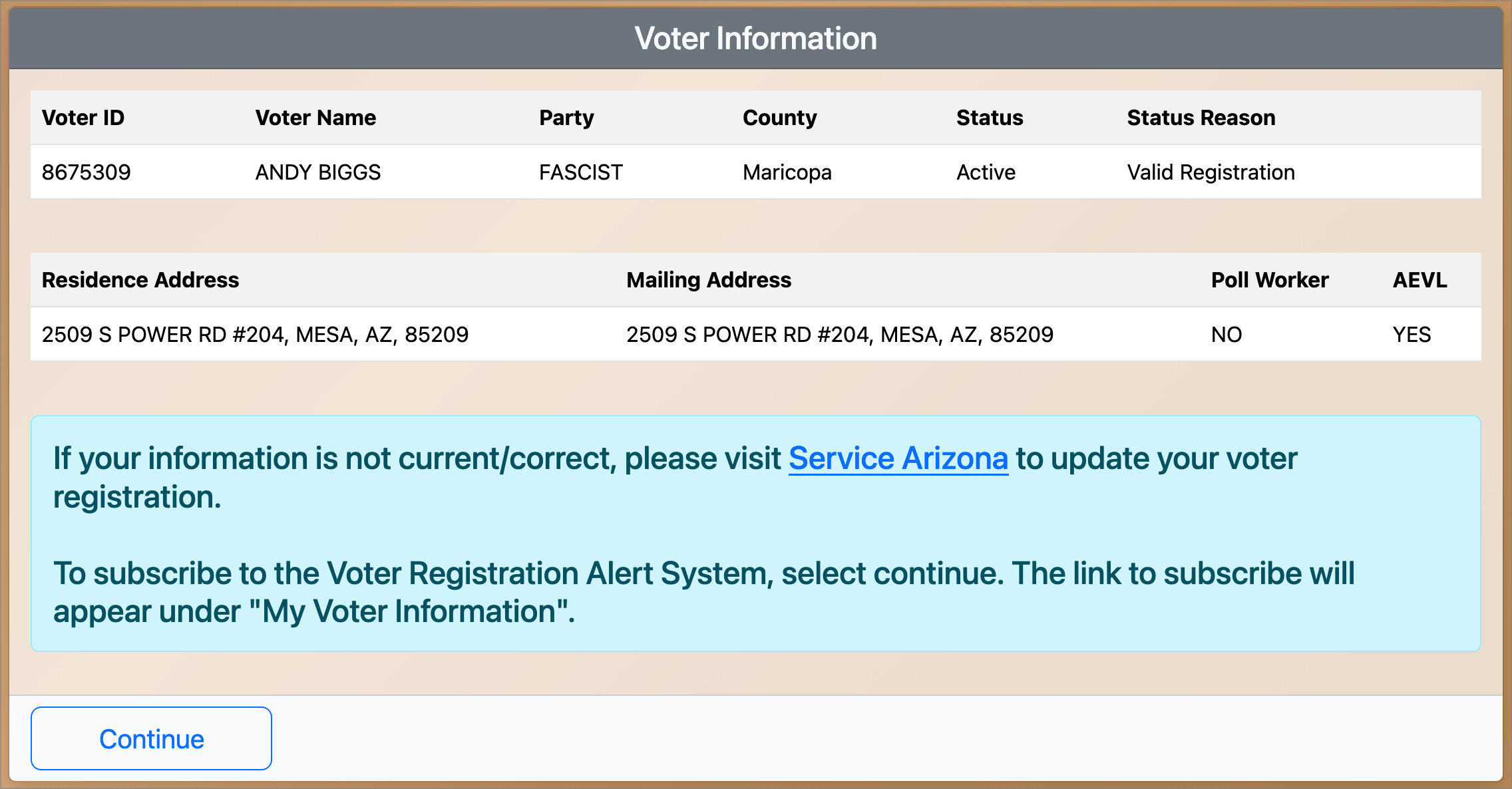
Example of an active voter registration on my.arizona.vote
- Sign up for the Permanent Early Voting List (PEVL) — Arizona will automatically mail you a ballot before every election you're eligible to vote in.
- Vote in every election — Not just presidential years. School boards, city councils, and state legislators are elected in off-years when turnout is lowest. That's where your vote has the most impact.
Civic Engagement Beyond Voting (CEBV)
Our favorite resource for Arizonans who want to do more.
Civic Engagement Beyond Voting is a grassroots Arizona 501(c)(4) organization that trains and empowers residents to participate in state and local governance. They're the ones who made RTS accessible (see above), but they do far more than that.
CEBV offers regular trainings on how the Arizona Legislature works, how to effectively testify, how to track bills, and how to engage with your local government — from school boards to city councils. They publish a weekly newsletter during the legislative session that breaks down what's happening at the Capitol in plain language.
As they put it: "Virtually all the experiences in your daily life are affected by local government" — from infrastructure to education to the criminal justice system. CEBV helps you understand how to influence those decisions.
Stay Informed
You can't fight what you can't see.
Keeping track of what's happening in the Arizona Legislature doesn't require a political science degree. A few key bookmarks and 15 minutes a day will keep you ahead of most voters.
Essential Bookmarks
- AZ Legislature Bill Status — Search and track any bill by number, keyword, or sponsor.
- Committee Hearing Schedule — See what's being heard this week and which bills are on the agenda.
- Arizona Mirror — Independent, nonprofit journalism covering Arizona politics and policy.
- r/azpolitics — Arizona political discussion on Reddit.
- r/AZAdvocacyHub — Find Arizona advocacy organizations and resources.
- AAF — Fascist Laws — Our own tracker of the worst bills moving through the legislature.
- Civic Engagement Beyond Voting (CEBV) — Trainings, newsletters, and tools to engage with Arizona state and local government.
- Secular AZ — Defending the separation of church and state in Arizona politics and policy.
Sign Candidate Petitions with E-Qual
Help candidates get on the ballot — from your couch.
In Arizona, candidates must collect a minimum number of petition signatures to appear on the ballot. Traditionally, this meant tracking down a canvasser with a clipboard. Not anymore.
The Arizona Secretary of State's E-Qual system lets registered voters electronically sign candidate nominating petitions — securely, from anywhere with internet access. It covers federal, statewide, legislative, county, city, town, and precinct committeeman races.
Why This Matters
Getting on the ballot is the first hurdle every candidate faces. By signing petitions through E-Qual, you directly help the candidates you believe in clear that hurdle — without leaving your home. It takes about 5 minutes.
Go to E-QualImportant Rules
- Party registration matters — For primary election petitions, you can only sign for candidates whose party matches your voter registration. General election petitions (party listed as "NONE") are open to all registered voters regardless of party.
- Signature limits apply — You can only sign a limited number of petitions per office (e.g., 1 for Governor, 2 for State Representative). E-Qual tracks this for you.
- You must be a registered voter — E-Qual verifies your identity against the state voter registration database using your name, date of birth, and either your Driver License number or your Voter ID + last 4 of your SSN.
Not Sure How It Works?
The E-Qual system can be confusing the first time. We put together a step-by-step guide that walks you through the entire process — from logging in to understanding what you'll see on the petition list.
Read Our E-Qual Guide